Articles

Seaborne exports of Russian oil and petroleum products from the Black Sea between the two embargoes. Main trends: Crude oil
29 January 2023
According to preliminary estimates, in January 2023, Russia's seaborne crude oil exports from the Black Sea will increase significantly. This growth will be from 15 to 35%, and the export volume will reach 3.4-4.2 million tons compared with 2.9 million tons in December 2022. This exceeds the increase in Russia’s crude oil exports from the Black Sea ports that occurred in December 2022 - the first month after the introduction of the EU embargo and the price cap on Russia’s oil exports. This growth was achieved mainly due to India. In December 2022, 75.3% of Russia’s oil was not subject to the price cap because it was shipped by tankers that did not belong to EU shipowners.

The "grain corridor" in the Black Sea in September-December 2022. Important statistics
22 January 2023
The average number of vessels arriving per day at the ports of Odesa as part of the Black Sea Grain Initiative is one of the indicators of military risks. In September 2022, it was 5.9 vessels per day; in October – 5.1; in November – 3.3; and in December – 3.2. That is, in November, as a result of Russia’s deliberate actions, the number of vessels receiving permits for voyages to Ukrainian ports almost halved. Blocking the "grain corridor" remains an integral part of Putin's plan for a new stage of the war. That is, in the event of a new Russian offensive, the "grain corridor" may be blocked.

Russia’s Black Sea crude oil exports to EU countries in December 2022 – early January 2023. The first violations of the embargo
13 January 2023
In December 2022, despite the embargo that came into effect on 5 December 2022, there wasn’t any significant decline in maritime exports of Russia’s crude oil from the Black Sea to EU countries. The volume of exports remained at the level of 1 million tons, the same as in November 2022. The volume of Russia’s Black Sea crude oil exports to EU countries, starting from the embargo date of 5 December 2022, even increased slightly: it amounted to about 560,000 tons - or 55% of the total volume of Russia’s Black Sea crude oil exports to EU countries in December 2022. The shipowners of all oil tankers that arrived with a cargo of Russian crude oil in EU countries in violation of the embargo in December 2022 are companies registered in Greece.

216 tankers exported crude oil and petroleum products from Russian Black Sea ports in December 2022: The database
31 December 2022
The Monitoring Group of the Black Sea Institute of Strategic Studies and BlackSeaNews, based on the results of its own monitoring, presents a database of seaborne exports of crude oil and petroleum products from Russian ports on the Black and Azov Seas in December 2022. In total, in December 2022, 216 tankers exported oil and petroleum products from Russian ports (excluding exports to Bulgaria and Romania). They transported a total of about 14.4 million tons of cargo.

In December 2022, 55 Tankers exported Kazakh Oil from the Russian Black Sea Port of Novorossiysk (Database)
31 December 2022
In December 2022, a total of 55 tankers exported CPC oil from the Russian port of Novorossiysk, excluding the exports to Bulgaria and Romania. Together they exported a total of about 7.4 million tons of oil, including 5.7 million tons to the EU and 1.7 million tons to other countries.

The last days before the embargo. Russia’s Black Sea crude oil exports in November 2022
15 December 2022
After the June 2022 decision on the future EU embargo, during the 6-month transition period, nine EU countries and the US together imported 9.3 million tons of Russian crude oil at the estimated total cost of $5.3 billion or about $0.9 billion per month. Consequently, after the embargo kicks in, assuming that Russia doesn’t find alternative buyers for its Black Sea oil, its future unearned income can be roughly estimated at the same level. Following the EU decision on sanctioning Russian maritime crude oil export starting December 5, 2022, in November, the total volume of Russia’s maritime crude oil export experienced a significant drop by almost 1 million tons.

184 tankers exported crude oil and petroleum products from Russian Black Sea ports in November 2022: The database
30 November 2022
In November 2022, 184 tankers exported oil and petroleum products from Russian ports (excluding exports to Bulgaria and Romania). They transported a total of about 10.3 million tons of cargo, including 2.6 million tons of Russian crude oil, 4.6 million tons of Kazakh CPC crude oil, and 3.1 million tons of Russian petroleum products.

In November 2022, 32 Tankers exported Kazakh Oil from the Russian Black Sea Port of Novorossiysk (Database)
30 November 2022
In November 2022, a total of 32 tankers exported CPC oil from the Russian port of Novorossiysk, excluding the exports to Bulgaria and Romania. Together they exported a total of about 4.6 million tons of oil, including 3.1 million tons to the EU and 1.5 million tons to other countries.

Russia’s crude oil exports from the Black Sea in April-October 2022 (2)
08 November 2022
Following the EU decision to introduce sanctions on the maritime export of Russian crude oil starting December 5, 2022 — Council Regulation (EU) 2022/879 of June 3, 2022 — we’ve observed the following trends: retention of the total volume of Russian crude oil Black Sea exports at 3.5 million tons; certain decrease in exports to EU countries; generally unsuccessful attempts of Russia to replace exports to the EU with those to other countries. The much talked about in the media reorientation of the crude oil exports to India and China, in fact, hasn’t materialized. A month before the introduction of sanctions, Russia has been able to compensate for only up to 4% of its crude oil exports to EU countries.

The April-October 2022 Exports of Crude Oil and Petroleum Products from Russian’s Black and Azov Seas Ports: General Trends and Database (1)
08 November 2022
After a significant May 2022 surge of 13.9 million tons per month, the total volume of Russian sea exports of crude oil and petroleum products from the Black and Azov sea ports, has been showing a steady downward trend to 10.7 million tons in October 2022. In view of the situation, Russia has been making consistent attempts to reorient its crude oil export flows from the EU+ states to other countries of the world. However, considering those a success would be premature. The introduction of the European embargo on the import of oil on oil mixtures may lead to Russian Black Sea crude oil exports crashing by half.
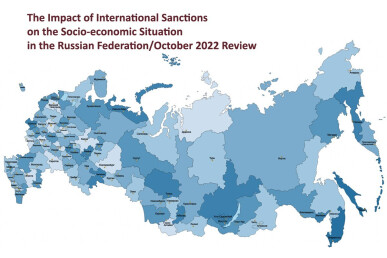
A Review of the Impact of International Sanctions on the Socio-economic Situation in the Russian Federation
07 November 2022
Putin's October 2022 statements have sent a clear signal: Russia wants to supply fuel to Europe. The start of the EU embargo on Russian maritime oil and petroleum products export on December 5, 2022, and February 5, 2023, respectively, could become a major turning point. The war, sanctions and trade blockade put the Russian economy on the «powder keg» of future trillion-dollar defaults. Russian economy is currently experiencing a growing jam of loan defaults. No sector of the Russian economy would remain unaffected by the current crisis caused by the large-scale war and Western sanctions. The sanctions hit Russia much more painfully than those who apply them.
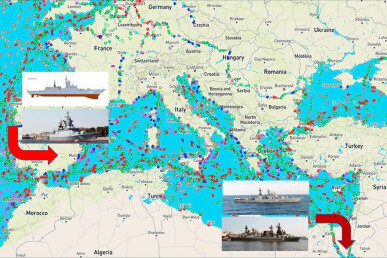
The presence of Russian warships in the Mediterranean Sea as of 6 November 2022
06 November 2022
As we have predicted earlier, Russia continues the reduction and rotation of its naval group in the Mediterranean. On 16 October 2022, 2 missile corvettes of the Russian Baltic Fleet - (531) Soobrazitelnyi and (545) Stoikiy - entered the Mediterranean Sea through the Strait of Gibraltar. On 21 October 2022, the missile cruiser (011) Varyag, the flagship of the Pacific Fleet of the Russian Federation (PF), the large anti-submarine ship (564) Admiral Tributs (PF), and the oil tanker/supply ship Boris Butoma left the Mediterranean Sea through the Suez Canal.

Production of military products at the captured plants of occupied Crimea in 2014-2022
03 November 2022
Russia’s failures in the all-out war against Ukraine and the actions of the Ukrainian Armed Forces have turned the Crimean Peninsula not only into a region near the frontline but also into an area of limited hostilities. This has created a fundamentally new reality in occupied Crimea — the anticipation of the Ukrainian offensive on the occupied peninsula, which affects all spheres of life there. These factors have put an end to the prospects of the Crimean economy sectors that under the occupation had been considered the primary ones — first of all, the defence industry.
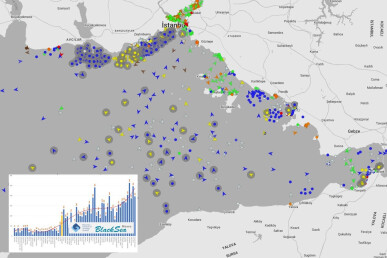
The “grain corridor”: Russia has artificially increased the waiting time for the inspection of ships carrying Ukrainian grain in the Sea of Marmara
01 November 2022
Since 18 September 2022, the waiting time for the “grain fleet” vessels to be inspected by the Joint Coordination Centre (JCC) in the Sea of Marmara has increased by 5 times and reached 11.3 days per vessel. Such a situation is totally disadvantageous for 3 out of 4 participants of the "grain initiative" - the UN, Turkey, and Ukraine. Our main assumption is that Russia is once again using this situation in connection with other issues - for example, the ceasefire on the front line, which is located at a distance of 40-60 km from the grain corridor area.

«Russian Сivilization» vs «Western Racism». Why Russia is Updating and Globalizing its Propaganda
21 October 2022
In recent weeks, the rhetoric of Russian top politicians has become notably peppered with the expressions «Russian civilization» and «Western racism». While the process has been obviously accelerated by the autumn defeats of the Russian Army in Ukraine, the expressions themselves have obtained new colors and interpretations. According to our monitoring, the term «Russian civilization» is being personally pushed by top officials in the Kremlin and Russia’s Ministry of Foreign Affairs. In Russian rhetoric, the term «Russian civilization» is promoted simultaneously with «racism» when referring to the actions of the West against Russia in general and Russians in particular.