Articles

Blood-Soaked Export. The Database of Oil Tankers Exporting Russian Oil From the Black Sea (Upon Passing Through the Bosphorus and Dardanelles). Part 1: March-July 2022
15 March 2022
Blood-Soaked Export. The Database of Oil Tankers Exporting Russian Oil From the Black Sea (Upon Passing Through the Bosphorus and Dardanelles)

Russian invasion of Ukraine: The situation as of March 13, 2022
14 March 2022
Total combat losses of Russian troops from 24.02 to 13.03. were estimated at over 12 thousand people, over 374 tanks, 1,826 armored vehicles and automotive equipment and 160 aircrafts (planes and helicopters). The Russian Federation recruited a large number of mercenary fighters from other countries, such as Syria and Serbia, to replenish its losses.

Blood Oil: The Greek Oil Tanker NISSOS CHRISTIANA Transports 100,000 Tons of Russian Oil to Istanbul
13 March 2022
The Monitoring Group of BlackSeaNews and the Black Sea Institute of Strategic Studies reports: On 13 March 2022, the Greek oil tanker NISSOS CHRISTIANA was detected in the Black Sea, going from the port of Novorossiysk (RU) to the port of ISTANBUL (TR) with a cargo of about 100,000 tons of Russian oil. ETA: 2022-03-14 11:00 LT (UTC +3). Reference: 100,000 tons of Russian URALS oil costs about $68 million, which is equivalent to the cost of about 10 Russian Kalibr cruise missiles.

Russian invasion of Ukraine: The situation as of March 12, 2022
13 March 2022
Total combat losses of the Russian troops from 24.02 to 12.03 were estimated at over 12,000 men, over 362 tanks, 1,790 armored vehicles and automotive equipment, and 141 aircraft (planes and helicopters). The threat of participation of the Belarusian army in the war against Ukraine persisted, and five battalion-tactical groups were sent to the border with Ukraine. The main objective of Russian troops continued to be the destruction of civilian infrastructure and inflicting maximum damage on the civilian population.

Blood Oil: The U.S. Oil Tanker MEDITERRANEAN VOYAGER Transports 100,000 Tons of Russian Oil to Rotterdam
13 March 2022
The Monitoring Group of BlackSeaNews and the Black Sea Institute of Strategic Studies reports: On 13 March 2022, the U.S. oil tanker MEDITERRANEAN VOYAGER was detected in the Black Sea, going from the port of Novorossiysk (Russia) to the port of ROTTERDAM (NL) with a cargo of about 100,000 tons of Russian oil. Reference: 100,000 tons of Russian URALS oil costs about $68 million, which is equivalent to the cost of about 10 Russian Kalibr cruise missiles.

Blood Oil: The Finnish Oil Tanker SWORD Transports 100,000 Tons of Russian Oil to France
12 March 2022
The Monitoring Group of BlackSeaNews and the Black Sea Institute of Strategic Studies reports: on 12 March 2022, the Finnish oil tanker SWORD was detected in the Black Sea, going from the port of Novorossiysk (Russia) to the port of Fos-Sur-Mer (France) with a cargo of about 100,000 tons of Russian oil. Reference: 100,000 tons of Russian URALS oil costs about $68 million, which is equivalent to the cost of about 10 Russian Kalibr cruise missiles.

Russian invasion of Ukraine: The situation as of March 9, 2022
10 March 2022
Total combat losses of Russian troops from 24.02 to 09.03 were estimated at over 12,000 men, more than 317 tanks, 1,552 pieces of armored and automotive equipment and 130 aircraft (planes and helicopters). The aggressor continued to focus its main efforts on encircling the city of Kyiv and capturing the cities of Sumy, Kharkiv, Mariupol and Mykolaiv. The Republic of Belarus supported the Russian Federation in supplying fuel and lubricants, using railway infrastructure and the airfield network.

Russian invasion of Ukraine: The situation as of 8:00, March 8, 2022
09 March 2022
Total combat losses of the Russian troops from 24.02 to 08.03 were estimated at over 12,000 men, over 303 tanks, 1,510 armored vehicles and vehicles and 128 aircraft (planes and helicopters). The Air Force of the Armed Forces of Ukraine successfully repelled enemy missile and air attacks and provided air cover for critical facilities in Ukraine and troop groups. The Kyiv defense forces continued to defend the capital along the outer defense line and in additionally defined directions.

The Presence of Russian Warships in the Mediterranean Sea as of 9 March 2022
09 March 2022
The formation of a huge "Mediterranean Squadron" of the Russian Navy in February 2022, using the Northern, Baltic, and Pacific Fleets’ ships allowed the Russian Black Sea Fleet to return a large number of ships to the Black Sea a few days (weeks) before Russia’s attack on Ukraine. In addition, Russia redeployed 7 amphibious assault ships from the Mediterranean to the Black Sea, including 6 major amphibious assault ships of the Northern and Baltic Fleets. However, the fact that Russia has failed to redeploy additional powerful missile surface combatants to the Black Sea has called into question the effectiveness of a possible amphibious operation on the Ukrainian Black Sea coast.

Russian invasion of Ukraine: The situation as of 8:00, March 7, 2022
07 March 2022
Total combat losses of Russian troops from 24.02 to 06.03 were estimated at over 11 thousand people, over 280 tanks, 1,270 armored vehicles and over 90 aircraft (planes and helicopters). The Russian Armed Forces kept attacking, in spite of significant losses in personnel and equipment. The supply of fuel and other materiel continued from the territory of the Republic of Belarus through the Chornobyl Exclusion Zone.

The Duration of Artificial Delays of Vessels in the Kerch Strait. The Monitoring for January 2022
16 February 2022
In January 2022, vessels carrying exports from Mariupol and Berdiansk were delayed at the exit from the Sea of Azov by the RF for an average of 60.6 hours. In 2019–2020, due to the threat of the "Azov package" of international sanctions, there was a slight decrease in the average duration of artificial delays of ships at the exit from the Sea of Azov to the Black Sea: in 2018 − 79.5 hours; in 2019 − up to 37.4; in 2020 − 29.6. In 2021, this figure increased significantly to 39.8 hours per vessel.
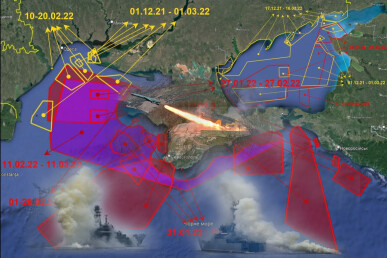
Increased Risks. Obstruction of Traffic in the Black and Azov Seas by Russia due to the Closure of Sea Areas for Military Exercises as of 15 February 2022
15 February 2022
This analytical review presents the results and conclusions made by the Monitoring Group of Black Sea Institute of Strategic Studies and the editorial board of BlackSeaNews based on monitoring in January-February 2022 the following area: Obstruction of traffic in the Black Sea and the Sea of Azov by the Russian Federation due to closures of sea areas for or under the pretext of military exercises.
The Presence of Russian Warships in the Black Sea and the Mediterranean Sea in January 2022
01 February 2022
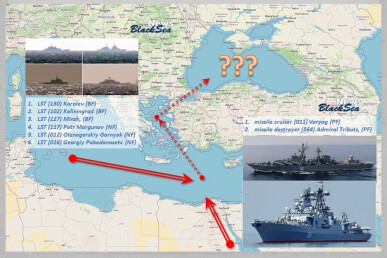
In January 2022, the number of Russian warships in the Mediterranean Sea changed dramatically. 6 major landing ships from the Baltic and Northern Fleets joined the "Mediterranean Squadron" of the Russian Federation. A missile cruiser and a missile frigate from the Pacific Fleet are expected to arrive via the Suez Canal. Thus, in February 2022, the Russian naval group in the Mediterranean Sea will have 18 major warships, including 8 missile ships (in December 2021, these figures were 8 and 5 respectively)

The 2021-January 2022 presence of non-Black Sea NATO states’ warships in the Black Sea
26 January 2022
According to the Monitoring Group’s data, as of January 25, 2022, in 2022, only one non-Black Sea NATO state warship stayed in the Black Sea. That is, at the time when the Russian military threat to Ukraine has dramatically escalated in January 2022, warships of the non-Black Sea NATO have been absent in the Black Sea for 21 days, obviously increasing the risk of aggression from the sea over the holidays

The Duration of Artificial Delays of Vessels in the Kerch Strait. The Monitoring for December 2021
05 January 2022
From December 2018 to December 2020, due to the threat of the "Azov package" of international sanctions against Russian ports on the Sea of Azov, there was a slight decrease in the average duration of artificial delays of ships at the exit from the Sea of Azov to the Black Sea: in 2018 − 79.5 hours; in 2019 − up to 37.4 hours; in 2020 − 29.6 hours per vessel. In 2021, this figure has increased significantly to 39.8 hours per vessel and already exceeded those for 2019 and 2020.