Maritime Oil Exports from Russian Ports, Excluding Kazakh Oil, in August 2026
Based on independent monitoring by the Black Sea Institute of Strategic Studies, Ukraine
September 4, 2026, No. 01–09
The data presented in this report comes exclusively from the Database of Tankers Carrying Russian Oil and Petroleum Products, developed and maintained by the Monitoring Group of the Black Sea Institute of Strategic Studies – https://tankers.blackseanews.net/
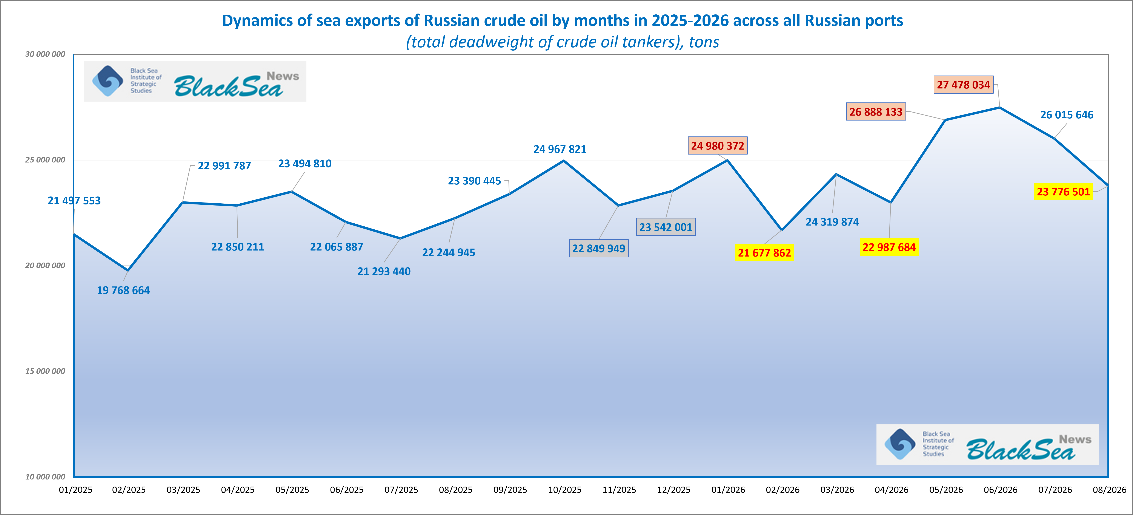
Our monitoring shows that Russia shipped the total *of 23 776 501 million metric tons (MMT) of crude oil from its ports in August 2026, down 2.2 MMT (-8.6%) from July and 3.7 MMT (-13.5%) from the record 27.4 MMT shipped in June.
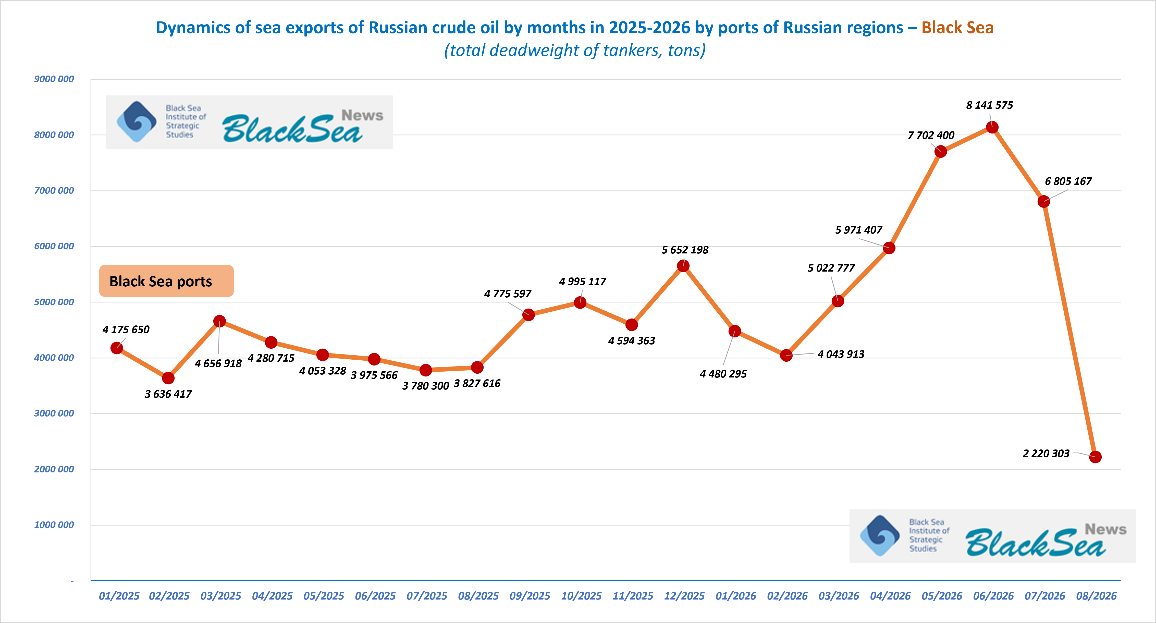
The entire decline was due to the impact of the Ukrainian Defense Forces’ strategic operation against Russian oil exports in the Black Sea, where shipments fell by 4.5 MMT, or 3.1 times compared with the previous month, from 6.8 to 2.2 MMT.
Russia’s previous lows in 2026 maritime crude oil exports were recorded in February, when the Gulf of Finland froze over, and in April, following Ukrainian attacks that damaged Baltic Sea ports.
However, of the 4.5 MMT drop, 2.3 MMT were offset by increases from Baltic Sea ports (+0.44 MMT), the Arctic (+0.57 MMT), and the Far East (+1.33 MMT).
Even with these gains elsewhere, the drop in Black Sea shipments significantly reshaped the regional breakdown of Russia’s crude oil exports in August.
From January through July 2026, Black Sea ports accounted for 20–29% of Russia’s crude oil exports. In August, their share fell to just 9.3%.
As of September 1, 2026, the breakdown was as follows:
| Port region | DWT тонн | % |
| Baltic Sea ports | 11 908 408 | 50,08 |
| Far East ports | 7 597 521 | 31,95 |
| Black Sea ports | 2 220 303 | 9,34 |
| Northern ports | 2 050 269 | 8,62 |
| TOTAL | 23 776 501 | 100,00 |
With that, further growth in seaborne exports from Russia’s Far Eastern and Arctic ports is unlikely given their current capacity constraints.
Outlook: If the current trend in the Black Sea continues, Russia will potentially step up efforts to increase seaborne crude oil exports through its Baltic Sea ports. Meanwhile, crude oil exports from the Black Sea are likely to consist primarily of Kazakh oil shipped through the Caspian Pipeline Consortium (CPC) terminals outside the Port of Novorossiysk.
To be continued...
Notes:
1 In this report, total export volume refers to the combined DWT of all crude oil tankers that departed Russian ports in the Baltic and Black Seas, as well as the Far East and Arctic, with cargo in August 2026.
This figure may change slightly in the days following publication as voyage data are continuously reviewed and updated.
The total may also include a small amount of heavy cargo other than crude oil, such as certain types of fuel oil, which account for only a few percent of the overall volume and do not affect the broader trends.
DWT includes the weight of the crew and their personal belongings, as well as bunker fuel, water, and provisions carried aboard. These make up only a negligible share of the total DWT of the tankers most used for shipments from Russian ports, which typically have a DWT capacity of 100,000–150,000 t..
Our monitoring never relies on shipping-volume data from third-party analytical sources or media outlets, since it may draw on sources linked to Russia and may also fail to account for the operational and technical measures used by Russia and tanker crews to conceal voyages. These include: switching off AIS transponders, jamming or manipulating AIS signals using electronic warfare systems, GPS spoofing, and the like.
More on the topic
- 01.07.2026 Maritime Export of Russian Crude Oil from Baltic Sea Ports in May 2026
- 01.07.2026 Maritime Export of Russian Crude Oil from Black Sea Ports in May 2026
- 04.06.2026 The Real State of Russian Maritime Oil Exports from Russian Ports in 2025, Part II: The Black Sea
- 02.06.2026 Maritime Export of Russian Crude Oil from Black Sea Ports in April 2026
- 01.06.2026 Maritime Export of Russian Crude Oil from Baltic Sea Ports in April 2026
- 09.05.2026 Maritime Exports of Russian Petroleum Products Through its Baltic Sea Ports: March 2026 Database
- 08.05.2026 Maritime Export of Russian Crude Oil from Baltic Sea Ports in March 2026
- 07.05.2026 Maritime Export of Russian Crude Oil from Black Sea Ports in March 2026
- 17.04.2026 Maritime Exports of Russian Petroleum Products Through its Baltic Sea Ports: February 2026 Database
- 17.04.2026 Maritime Export of Russian Crude Oil from Baltic Sea Ports in February 2026
- 16.04.2026 Maritime Export of Russian Crude Oil from Black Sea Ports in February 2026
- 08.04.2026 Database of Ukrainian Attacks on Russian Ships in the Black and Azov Seas In March 2022-April 2026